
Making logic gates from transistors
Ben Eater · 2 HN recommenders
Ben Eater shows how to build logic gates out of transistors, including NOR gates. It is part of his clear hardware-from-scratch teaching style.
THE ARCHIVE · EVERY DISCOVERY
3,553 videos with summaries and linked Hacker News recommendations, arranged by title.
Ben Eater · 2 HN recommenders
Ben Eater shows how to build logic gates out of transistors, including NOR gates. It is part of his clear hardware-from-scratch teaching style.

Nizzotch · 2 HN recommenders
A timelapse of Notch (Markus Persson) making Metagun, a game built from scratch in 48 hours for Ludum Dare 18. It shows the whole coding session sped up.

Townsends · 2 HN recommenders
The Townsends channel shows how to make mushroom ketchup, a popular 18th-century sauce, in period style. It includes the history and a recipe and links to a blog post on whether George Washington used ketchup.

Jim Pavloff · 5 HN recommenders
Jim Pavloff rebuilds the Prodigy track Smack My Bitch Up in Ableton, identifying the samples used and recreating the track by hand.

Jim Pavloff · 3 HN recommenders
Jim Pavloff rebuilds The Prodigy's 'Voodoo People' in Ableton from its listed samples. The video shows how the track is assembled and how close a handmade reconstruction can sound.

Mika Tuomi · 2 HN recommenders
Home video from 1993 showing Future Crew members at Mika Tuomi's home finishing the PC demo Second Reality shortly before release.

John O'Neill · 3 HN recommenders
Jan Vitek of Northeastern University gives a meetup talk on the challenges of making the R language run fast. He explains what in R's semantics makes it hard to optimize and to build a JIT compiler for.

People Make Games · 2 HN recommenders
People Make Games explores VRChat, the social virtual world that many consider the metaverse people actually like, interviewing users and covering its communities and uncertain future.

KRAZAM · 2 HN recommenders
KRAZAM parody sketch in which an Excel streamer, Makro, treats the XLOOKUP function as a game-breaking meta change, spoofing e-sports commentary.
Happen Films · 4 HN recommenders
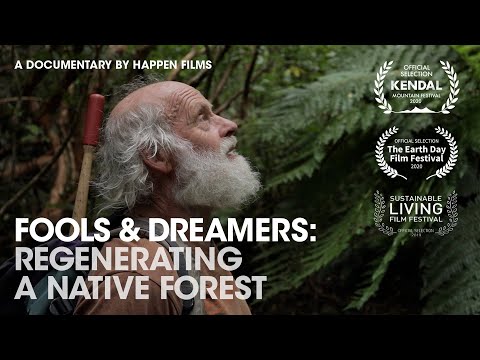
Fools & Dreamers is a 30-minute documentary about Hinewai Nature Reserve in New Zealand, where botanist Hugh Wilson let gorse grow as a nurse canopy to regenerate native forest. It shows the results after 30 years and the local skepticism he faced.

SmarterEveryDay · 2 HN recommenders
Part 1 of Smarter Every Day's three-part series on manipulating the YouTube algorithm. It features Renee DiResta and examples of how social media platforms can be manipulated.

Folding Ideas · 6 HN recommenders
Dan Olson of Folding Ideas critiques Fortnite's monetization, arguing it uses manufactured discontent, such as shop design and skins, to push spending. The video dissects the psychological techniques behind the game's business model.

CodeParade · 2 HN recommenders
A demo of Marble Marcher, a game using a fractal physics engine and fully procedural ray-marched rendering. The player rolls a marble through shifting fractal levels.

Marc Levoy · 5 HN recommenders
The first lecture in an 18-part series on digital photography from Marc Levoy's Stanford CS 178 course, recorded at Google in 2016. The series covers how digital cameras work and computational photography, with slides and assignments available on the course site.

손주일 (Cecil) · 2 HN recommenders
Marco Baringer's tutorial video on SLIME, the Emacs mode for developing Common Lisp. It demonstrates the interactive workflow of working against a live Lisp image.

Michael Sugrue · 4 HN recommenders
Michael Sugrue's lecture on Marcus Aurelius' Meditations and the Stoic ideal, covering the text and its philosophy. It is one of his humanities lectures known for their clarity.

Extractor · 5 HN recommenders
A clip from the 2011 film Margin Call in which senior partners hold an emergency meeting and decide to sell off toxic assets immediately. It is set at the start of the 2008 financial crisis.

Movieclips · 4 HN recommenders
A clip from the 2011 film Margin Call in which a firm's CEO, played by Jeremy Irons, tells a senior executive about the cycles of financial crashes. Kevin Spacey's character says he wants out, and the scene ends on the line that it is just money.

SethBling · 10 HN recommenders
SethBling shows MarI/O, a program using neural networks and the NEAT genetic algorithm to learn to play Super Mario World. The description links the source code, the paper and background reading.

McMaster Humanities · 2 HN recommenders
Political economist Mark Blyth gives a lecture tracing two versions of capitalist 'software': the postwar Great Compression era and the neoliberal era from 1980 to 2008. He explains the bug that crashed the first and the design of the second.

Watson School of International and Public Affairs · 3 HN recommenders
Mark Blyth's 2016 Brown University lecture on global Trumpism, explaining the rise of populism through economics, the decline of Western middle classes and revolt against technocracy.

JSConf · 4 HN recommenders
A JSConf 2014 talk visually breaking down algorithms behind everyday UI patterns, such as dropdown menus that vanish when the mouse drifts and picking the nearest target to the cursor. It shows how these are implemented in JavaScript.

Lex Fridman · 3 HN recommenders
Lex Fridman interviews Mark Zuckerberg in the metaverse, with both appearing as photorealistic avatars from separate locations. They discuss Meta's AI, VR and the future of avatars.

Sean Barrett · 2 HN recommenders
A one-minute capture of Tim Clarke's 1993 'Mars' DOS demo, a roughly 5 KB program that renders a navigable terrain landscape in real time.

Veritasium · 10 HN recommenders
Veritasium's Derek Muller visits NASA JPL to see the Mars helicopter Ingenuity before it was mounted on the rover. He explains how it can fly in Mars's thin atmosphere with large, fast-spinning contra-rotating rotors and low mass, and covers power and cold.
Pierce College District WA · 6 HN recommenders
Psychology professor Marty Lobdell gives a one-hour lecture on how to study effectively, covering short focused sessions with breaks, study environment, note-taking and memory techniques. It was aimed at students who cram without improving.
TED · 4 HN recommenders
Luis von Ahn, creator of CAPTCHA and reCAPTCHA, explains how small contributions from many people online can digitize books. He then introduces Duolingo as a way to translate the web while people learn languages.

Andrew Huberman · 7 HN recommenders
Andrew Huberman's podcast episode on what makes us sleepy, helps us sleep soundly and keeps us alert. It lays out the science and a set of behavioral tools such as light timing.
thoughtbot · 5 HN recommenders
Chris Toomey of thoughtbot explains Vim as a language of commands, motions and text objects that combine into precise edits. He shows how to master the built-in pieces and extend them.

National Museum of Mathematics · 3 HN recommenders
Mathematician Colin Wright demonstrates juggling and explains the mathematics of juggling patterns, including notation that led to new throwing patterns. It is a public presentation at the Museum of Mathematics aimed at a general audience.

Vsauce · 2 HN recommenders
Vsauce explores math through card tricks and big numbers, including an animation of how enormous 52 factorial, the number of deck orderings, really is.
Veritasium · 7 HN recommenders
Veritasium's explainer on Godel's incompleteness theorems and the limits of mathematical proof, tracing set theory, Hilbert's program and the road to Turing and modern computing.

Matrixdotorg · 2 HN recommenders
A FOSDEM 2023 talk from the Matrix team on Matrix 2.0, covering sliding sync, the Element X client rewrite and next-generation calling. It explains how Matrix aims to match the speed of proprietary messengers.

Ryuujin131 · 2 HN recommenders
A short English-subtitled clip of Shuzo Matsuoka, a retired Japanese tennis player turned motivational speaker, delivering a never-give-up pep talk. It is a well-known Japanese internet meme.

Curry On! · 3 HN recommenders
Matt Might's Curry On talk on ending errors in code, both software and the human genome. He covers conservative approximation of the halting problem via static analysis and a computational approach to precision medicine.

Harvard Extension Student Psychological Club · 2 HN recommenders
Developmental and synthetic biologist Michael Levin speaks at a Harvard Extension student event on bioelectricity, body intelligence and regenerative medicine. He discusses how cell electrical networks guide growth and form.

Kevin Galvayne · 2 HN recommenders
The 1985 Channel 4 TV film 'Max Headroom: 20 Minutes into the Future', the origin of the computer-generated TV host Max Headroom, with a soundtrack by Midge Ure and Chris Cross.

Lex Fridman · 2 HN recommenders
Lex Fridman interviews MIT physicist Max Tegmark, co-founder of the Future of Life Institute, about the case for pausing giant AI experiments and the risks of advanced AI.

Andrew Huberman · 3 HN recommenders
A long Huberman Lab episode laying out science-based daily tools for focus, sleep, exercise and mental and physical health, organized around a 24-hour day.

Road Less Marveled · 9 HN recommenders
Seven-minute footage of Fred Rogers testifying before a US Senate subcommittee in 1969 to defend federal funding for the new Corporation for Public Broadcasting. A skeptical Senator Pastore starts out abrasive and is won over during Rogers' brief, calm testimony.

ClojureTV · 14 HN recommenders
Rich Hickey's Clojure/Conj 2018 keynote argues that Maybe/Option types and rigid type signatures are a poor way to model data that changes over time. He builds the case around optionality, schema growth and compatibility, and presents the ideas behind Clojure spec as an alternative.

MC Frontalot · 5 HN recommenders
MC Frontalot's nerdcore rap about the text adventure Zork, made for Jason Scott's Get Lamp documentary and featuring a cameo by Steve Meretzky. It was filmed over an evening in a basement.

Automotive Mike · 3 HN recommenders
Coverage of the McMurtry Speirling fan car breaking the Goodwood hillclimb record with a 39.08 second run driven by Max Chilton. It beat the Volkswagen ID.R and the 1999 McLaren time.

Google TechTalks · 3 HN recommenders
A Google Tech Talk by Sebastian Deterding on gamification. It looks at what points and badges get wrong and what lessons game design offers for non-game applications.

Excelsior10000 · 13 HN recommenders
A 1953 US Navy training film explaining the basic mechanisms in mechanical fire control computers aboard ships. It shows how gears, differentials and cams solved mathematical problems in permanent mechanical form.

Sam Holmes Sailing · 3 HN recommenders
Sam Holmes Sailing visits sailing legend Sven Yrvind and tours his boat, covering the man and his small-boat design philosophy.

TEDx Talks · 4 HN recommenders
Documentary filmmaker Cassie Jaye explains how making The Red Pill led her, a feminist, to reevaluate her assumptions about the Men's Rights movement. She argues for listening to people you think of as the enemy.

Megaprocessor · 2 HN recommenders
A short tour of the Megaprocessor, a microprocessor built at enormous scale from tens of thousands of discrete transistors. The builder shows what the machine is made of and where it now lives, at the Centre for Computing History in Cambridge, where visitors can play Tetris on it.

mitxela · 2 HN recommenders
mitxela shows his KiCad plugin that rounds PCB tracks to give circuit boards organic, melted-looking layouts instead of rigid geometric ones.

Stand-up Maths · 2 HN recommenders
Matt Parker of Stand-up Maths demonstrates MENACE, Donald Michie's 1961 machine made of matchboxes that learns to play noughts and crosses through reinforcement. He builds and trains a physical version.

Every Frame a Painting · 3 HN recommenders
An Every Frame a Painting video essay on Michael Bay's style, 'Bayhem', covering his camera movement, composition, color and editing. It argues that even if you dislike his films, they teach something about visual perception.

JayMJ23 · 2 HN recommenders
A Nike commercial in which Michael Jordan lists the shots he missed and games he lost, saying that repeated failure is the reason he succeeds.

Thomas Ouldridge · 3 HN recommenders
Michael Levin presents his lab's work on how cellular collectives use bioelectric networks to make anatomical decisions. Topics include pattern memories, regeneration and synthetic living organisms.
Lex Fridman · 3 HN recommenders
Lex Fridman talks with Tufts biologist Michael Levin about bioelectricity, embryogenesis, xenobots and how cells collectively pursue goals. They range into cognition, evolution and the possibility of aliens.

Curt Jaimungal · 3 HN recommenders
Curt Jaimungal interviews biologist Michael Levin of Tufts about consciousness, bioelectricity, emergence, and cancer research. The conversation challenges reductionist views of life.

TED · 7 HN recommenders
Biologist Michael Levin explains the bioelectric layer that coordinates cells to build organs and bodies, showing footage of two-headed worms and introducing xenobots. He discusses implications for medicine and the nature of life.
Michael Moore · 7 HN recommenders
Planet of the Humans, a full documentary by Jeff Gibbs presented by Michael Moore, arguing that the green movement has been co-opted by corporate and wealthy interests and that techno-fixes are not enough.

Y Combinator · 3 HN recommenders
Y Combinator CEO Michael Seibel lectures at Startup School on building a product people want: identifying the problem, the customer, an MVP and which customers to pursue first.

Michigan Engineering · 5 HN recommenders
Database pioneer Michael Stonebraker argues that 'big data' is really at least four different problems: big volumes with small analytics, big analytics, velocity, and variety. He comments on where each market is heading.

The Centre for Computing History · 2 HN recommenders
The Centre for Computing History reunites Chris Curry, Steve Furber and Hermann Hauser to rewatch the BBC drama Micro Men on its tenth anniversary. They reminisce about Acorn and the early British home computer era.