THE VIDEO SHELF · memory allocation
"Compacting the Uncompactable" by Bobby Powers
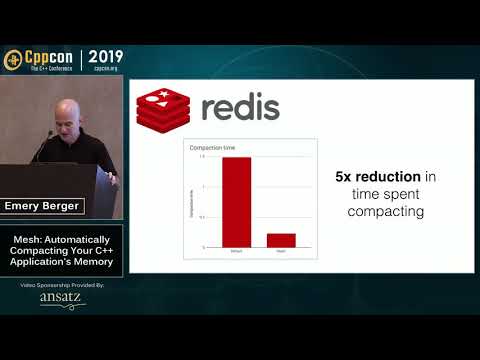
Bobby Powers presents Mesh, a drop-in malloc replacement that eliminates memory fragmentation in unmodified C/C++ programs by compacting memory. The talk covers how it works despite C's fixed object addresses, and its benefits for programs like Redis.
Why HN readers recommended it
Recommended as a great talk on solving fragmentation for C/C++ and runtimes like Ruby and Python without code changes.
This is a summary from the source dataset, not an endorsement by Hacker News or the video creator.
Video & recommendation details
- Creator / channel
- Strange Loop Conference
- Topic
- memory allocation
- Format
- talk
- Level
- advanced
- HN recommenders in dataset
- 3
- HN mentions in dataset
- 4
- Recommendation years in dataset
- 2020–2025
These counts and years describe the included Hacker News records; they are not YouTube views or the video’s publication date.
From the original HN conversations
Excerpts from the recorded comments. Follow each source for the full comment and surrounding discussion.
There's an interesting talk [0] from Bobby Powers on how to make a malloc() and free() that perform compaction, to be able to release memory back to the operating system more frequently (and improve cache hit rates, etc.). But this isn't standard at all yet. …
remexre on Hacker News · 2020-12
In How the Python object system worksThere was a great talk at Strange Loop about a drop-in malloc replacement which compacts. Apparently it actually led to memory usage improvements in industrial projects like Redis: [VIDEO]
rtfeldman on Hacker News · 2022-07
In Reference count, don't garbage collectThere’s a great paper from the group of Emery Berger, where they merge memory pages that become sparse. A kind of garbage collection for C and C++ languages. There’s also a good presentation about it on youtube. [LINK] The presentation: [VIDEO]
superjan on Hacker News · 2025-01
In Using black magic to make a fast circular buffer (2017)
Summaries, classifications and recommendation records are from the HackerTube source dataset. Read about this library and its limitations.